golfclubase

TaylorMade P·770 Irons vs Titleist T250 Irons

Shotmaking Feel or Raw Distance?

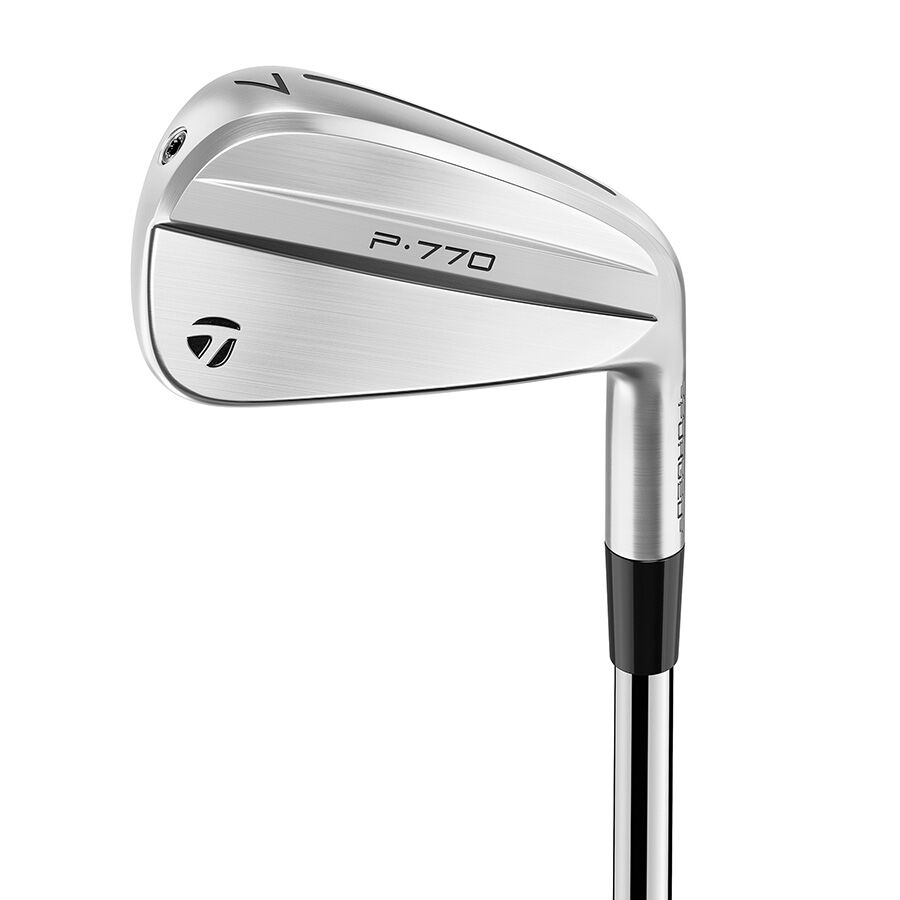
TaylorMade P·770 Irons

TaylorMade

P·770 Irons

2024 model

Release date
Sep 6, 2024
MSRP at launch
$1,399.99 (set of 7)
P·770 Irons details →
Titleist T250 Irons

Titleist

T250 Irons

2025 model

Release date
Aug 21, 2025
MSRP at launch
$215.00 (per club)
T250 Irons details →

Which to choose

The biggest difference is priority. The P·770 leans toward control and feel. Testers praise its soft, solid strike, its near-blade look and how easily it shapes shots. The T250 leans toward distance, with fast, consistent ball speed and a high, strong flight even on low-face strikes. That fits its stronger 30.5° 7-iron loft, compared with 33° on the P·770.

Both are compact hollow-body players' distance irons, and testers found both more forgiving than their size suggests. Feel separates them. The P·770 is described as soft, while the T250 is solid and lively but firmer than the softest irons in the class. Testers were split on distance for the P·770, while the T250 drew criticism for its price compared with what it gains.

Choose the P·770 Irons if…

you're a scratch to roughly 10-handicap player who wants a soft feel, a nearly blade-like look and an iron that's easy to shape and flight up or down, even with a mid-speed swing around 80-90 mph.

Choose the T250 Irons if…

you're a mid-handicapper or solid ball striker who puts distance first and wants fast, consistent ball speed and a high, strong flight from a compact head, and you don't mind a firmer feel.

Common questions

Which one goes farther?
The T250 is built more around distance, with fast, consistent ball speed and a stronger 30.5° 7-iron loft compared with 33° on the P·770. Testers were split on the P·770's distance: some found it a modest control iron, while others felt its long irons kept up with the P790.
Which feels softer?
The P·770. Most testers call it soft and solid on centre strikes, while the T250 feels solid and lively but firmer than the softest forged rivals. Both feel worse on mishits.
Which is more forgiving?
Testers found both more forgiving than expected for their size. The P·770 keeps a tight grouping on mishits, and the T250 holds carry on slight mishits but still rewards fairly consistent striking, so neither one clearly wins.

Written by golfclubase with AI from our summaries of published reviews and test videos and the makers' published specs (Oct 25, 2026).
Side by Side, Aspect by Aspect

Feel and Sound: the P·770 Is the Softer One

For the P·770, reviewers mostly described feel as soft and solid. One review said it holds up well for a hollow-body iron, one video found it softer than earlier versions, and another called it among the best-feeling irons the tester had hit. One reviewer heard a quiet, dull click on centered strikes, and said off-center hits sound louder and feel firmer. Reviewers called the T250 powerful, fast off the face and premium. One said it leans firm, and one video said it is not the softest in its class. On sound, it was described as crisp and more solid than before, though one video found it louder than the T100 and T150. The P·770 drew more 'soft' verdicts, while the T250 came across as livelier and firmer.

Looks at Address: Both Earn Blade-Like Praise

Two testing videos called the P·770 possibly the best-looking iron they had seen. Reviewers noted a compact blade, minimal offset and a sleek back. One reviewer said its topline is thinner than the P790's, while another called it fairly generous. One reviewer didn't like how the back of the 4-iron shows above the topline. The T250 got similar praise. Reviewers noted a thinner topline than the T200, a muted satin finish and a compact head with some offset, and one video gave its looks 10/10 and called it almost blade-like. Opinions on both models were very positive. The P·770 has the more minimal offset, and the T250's selling point is a cleaner look than its predecessor.

Launch and Spin: Height From Different Lofts

With a 33° 7-iron, the P·770 was said to launch higher than other irons at the same number and higher than the previous P·770. One review saw high long irons and more penetrating short irons. Reviewers were split on spin: one called it ample, like a cavity back, while another found it lower than traditional benchmarks. Testers did agree it stayed consistent. The T250 has a stronger 30.5° 7-iron, and one video said it still flies very high. One reviewer, though, launched it lower than his previous irons. One video described it as a lower-spinning head, while another reviewer saw slightly more spin with better consistency. Both get plenty of height, but the T250 gets there from a stronger loft.

Forgiveness: Both Beat Their Looks, With Limits

Reviewers often said the P·770 is more forgiving than it looks. One felt the maker's 'Mid' rating undersells it, and another found it clearly more forgiving than the P7CB. Testing videos reported tight dispersion and solid results on mishits. One review called it forgiving but not ultra-forgiving, and one video saw a clear distance loss on strikes low on the face. The T250 felt forgiving even on thin strikes to one reviewer, and one video found it more forgiving than the T150 and T200. Others noted that thin strikes lose some distance, heel or toe hits can feel thin, and you still need to find the middle. Each model has its own weak spot: low-face strikes on the P·770, and thin or heel-and-toe hits on the T250.

Shot Shape: P·770 Workable, T250 Straighter

For the P·770, one reviewer saw no draw bias because of the minimal offset and found it easy to shape fades and draws and to flight the ball high or low. One video also called it workable. Another tester, a natural drawer, disagreed: he found it hard to fade. One video noted that the offset is progressive through the set, with slightly more in the long irons. The T250 was discussed less. One reviewer simply called it workable, and one video said its reduced offset makes it fly straighter than the T200, which drew more than that tester wanted. Most reviewers who covered the P·770 found it easy to shape, though not all. The T250's reviews focused on a straighter flight.

Written by golfclubase with AI from what review articles and test videos said about each model, aspect by aspect (Oct 25, 2026).

Key differences

  • Loft: the T250 Irons is 2.5° lower than the P·770 Irons
  • Lie angle: the T250 Irons is 0.5° higher than the P·770 Irons

Specs side by side

P·770 Irons: 7I; T250 Irons: 7I (US models).

P·770 IronsT250 Irons
Loft33°30.5°−2.5°
Lie angle62.5°63°+0.5°
ConstructionForged—
Iron typeHollow body—
Face materialSteel—
Club length37″37″
Swing weightD2—

Values are as published by the makers. Sources are listed on each model's page.

The Numbers, Visualized

Where They Sit Among Irons

Compared with the reference club of every model in Irons on golfclubase (US specs; 7I / 7I). The line is the full range, the band the middle half, the tick the median.

LoftP·770 Irons 33°/T250 Irons 30.5°
27°35°

P·770 Irons ranks #13 highest of 107. T250 Irons ranks #43 highest of 107.

Lie angleP·770 Irons 62.5°/T250 Irons 63°
61.5°63.5°

P·770 Irons ranks #23 highest of 107. T250 Irons ranks #2 highest of 107.

Club lengthP·770 Irons 37″/T250 Irons 37″
36.25″37.5″

Both rank #9 shortest of 106.

Swing weightP·770 Irons D2
B8D3

P·770 Irons ranks #9 heaviest of 68.

Loft by ClubP·770 IronsT250 Irons
18°34°50°2I3I4I5I6I7I8I9IPWAW48W
Length by ClubP·770 IronsT250 Irons
35.50″37.50″39.50″2I3I4I5I6I7I8I9IPWAW48

What reviewers say

P·770 Irons

What reviewers like

  • Sleek, compact look at address with slim topline and minimal offset
  • Easy launch, including long irons, helping shots stop on greens
  • Forgiving for a players' iron, with tight dispersion on mishits
  • Soft, solid feel on centre strikes
  • Workable, easy to shape and flight the ball up or down

Watch out for

  • Off-centre hits sound louder and feel firmer
  • Long-iron heads are larger, and the 4-iron's back shows above the topline
  • Not built for high handicappers who need maximum forgiveness
Full overview of the P·770 Irons →

T250 Irons

What reviewers like

  • Clean, compact looks with a thinner topline than the T200
  • Fast, consistent ball speed for strong distance
  • High, strong flight, including on low-face strikes
  • Forgiving for its size, with consistent carry on slight mishits
  • More solid feel and sound than the previous model

Watch out for

  • Firm-leaning feel, not as soft as some forged rivals
  • Thin and heel or toe strikes can feel thin and lose distance
  • Expensive relative to the performance gain
  • Compact head still rewards fairly consistent ball striking
Full overview of the T250 Irons →

Lofts and clubs offered

P·770 Irons
3I / 4I / 5I / 6I / 7I / 8I / 9I / PW / AW
Set makeup: 4I / 5I / 6I / 7I / 8I / 9I / PW
T250 Irons
2I / 3I / 4I / 5I / 6I / 7I / 8I / 9I / PW / 48 / W
Set makeup: 2I / 3I / 4I / 5I / 6I / 7I / 8I / 9I / PW / GW

More comparisons