golfclubase

TaylorMade P·770 Irons vs Titleist T150 Irons

Easy Launch or Crisp Forged Feel?

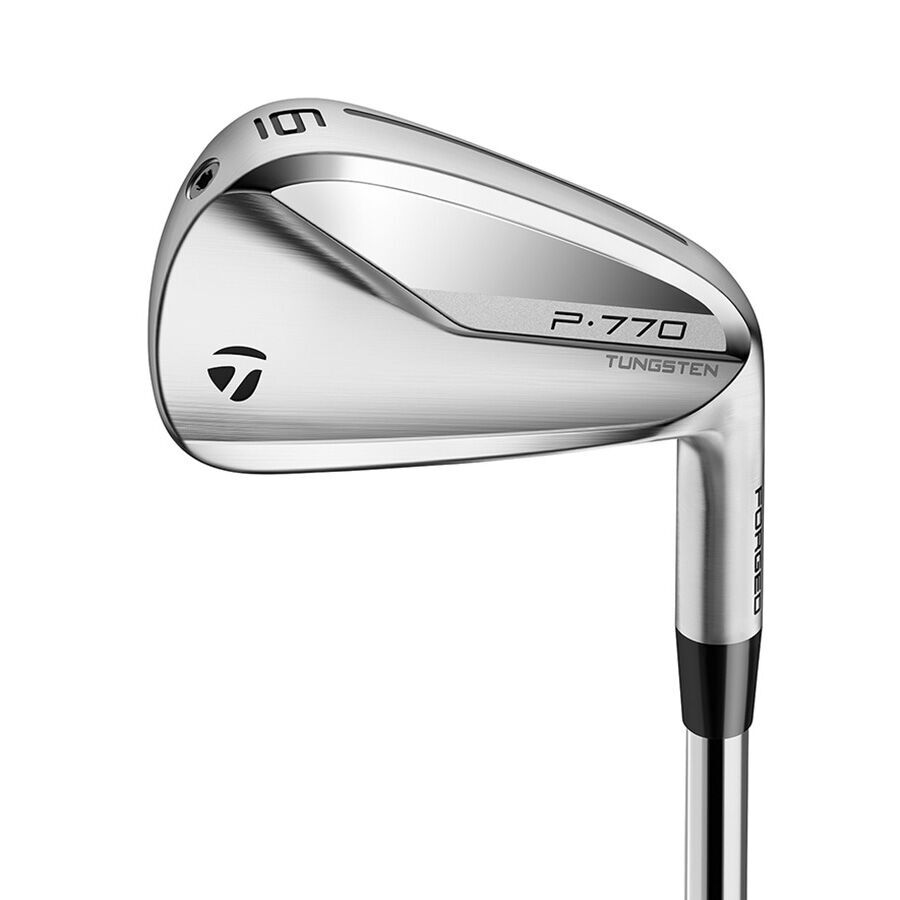
TaylorMade P·770 Irons

TaylorMade

P·770 Irons

2023 model

Release date
Jan 20, 2023
MSRP at launch
$1,224.99 (set)
P·770 Irons details →
Titleist T150 Irons

Titleist

T150 Irons

2023 model

Release date
Aug 25, 2023
MSRP at launch
—
T150 Irons details →

Which to choose

The biggest difference is what each one puts first. The TaylorMade P·770 is a hollow-body players' distance iron. Testers single out how high and easily its long irons launch, and how well distance holds up on mishits. The Titleist T150 is a forged players iron that sits between the T100 and T200. Its flight is close to the T100 or slightly higher, and testers praise its crisp feel and good feedback.

On paper the lofts are close. The P·770 7-iron is 33° and the T150 is 32°, and both are 37 inches long. The P·770 gives less feedback on strike than smaller players' irons. The T150 still demands a fairly good ball striker.

Choose the P·770 Irons if…

you want a compact, traditional look but need more help getting the long irons up high, and you aren't an especially long hitter.

Choose the T150 Irons if…

you're a low handicapper, or close to single figures, and want crisp forged feel with clear strike feedback and a T100-style look with extra distance.

Common questions

Which launches higher?
The P·770 is the one testers describe as launching high and easily, especially in the long irons. The T150's flight is described as similar to the T100 or a bit higher.
Which gives better feedback on strike?
The T150. Testers describe its strikes as solid and crisp with good feedback. The P·770 gives less feedback than smaller players' irons.
Can you shape shots with both?
Yes. Testers could shape the ball with both. With the P·770, low flighted shots can come out higher than intended.

Written by golfclubase with AI from our summaries of published reviews and test videos and the makers' published specs (Oct 25, 2026).

Side by Side, Aspect by Aspect

Launch and Spin: The P·770 Gets Long Irons Up

Reviewers kept coming back to how easily the P·770's long irons launch. In articles and testing videos, they credited its lower centre of gravity for a high flight, and one reviewer said it stayed high even on strikes low on the face. Reviewers found more spin than the P790. One reviewer said it spun less in the long irons than another model tested but still enough to hold greens. In one video, a low shot came out higher than intended. Two sources said the T150 launches like the T100 and lands steeply. Reviewers noted lower spin than the T100. In one video it also spun less than a rival, and the tester felt that could cost control from wet or semi-rough lies. Overall, the P·770 stands out for long-iron height, while the T150 keeps a T100-like flight with less spin.

Forgiveness: Both Help, Opinions Split on P·770

Most sources rated the P·770 highly for forgiveness. One reviewer called it outstanding, and others said distance and ball speed held up on mishits. One reviewer found it helpful on thin shots. In one testing video, though, the tester noticed a clear loss of distance on strikes low on the face, so views are split. Reviewers repeatedly described the T150 as more forgiving than the T100, especially in the long irons. One reviewer called it surprisingly forgiving for a players iron. Another stressed that it is still aimed at good ball strikers. One reviewer rated its forgiveness slightly below some competitors, and one tester found it less consistent than the T100 with the 7-iron. Reviewers framed the T150's forgiveness as a step up from the T100, while the P·770's was mostly judged on its own merits.

Feel and Sound: Solid Strikes From Both

Reviewers described the P·770 as solid and connected. One called it medium-soft, and another said it felt like a forged iron despite the hollow body. One tester put it among the best-feeling irons he had hit, while another said it lacks the ultra-soft feel of the MB and MC models. Opinions on sound ranged from quiet and low-pitched to impressive, and one reviewer noted it can sound loud in an echoing room. Reviewers called the T150's feel solid, or soft and solid. One reviewer praised the crisp feedback on centred strikes with no sting, and one tester said it felt close to the T100 and MB range. One reviewer rated its sound superb. Both drew some praise for feedback, but one reviewer listed lighter feedback as a P·770 drawback.

Workability: Mixed Views on Both Models

Reviewers disagreed about how easily the P·770 shapes shots. One reviewer found it easy to curve either way. In one testing video, the tester could play a small draw and hit low stingers. In another video, though, a tester who naturally draws the ball found fades hard to shape compared with other clubs he had used. Two sources did not address shot bias at all. For the T150, one reviewer praised its strong workability, with easy control of flight height and enough spin to curve the ball either way. In one video, the tester noticed a tendency to hit a slight fade. One tester struggled to fade the P·770, while the one shape tendency reported for the T150 was a slight fade.

Written by golfclubase with AI from what review articles and test videos said about each model, aspect by aspect (Oct 25, 2026).

Key differences

  • Loft: the T150 Irons is 1° lower than the P·770 Irons
  • Lie angle: the T150 Irons is 0.5° higher than the P·770 Irons

Specs side by side

P·770 Irons: 7I; T150 Irons: 7I (US models).

P·770 IronsT150 Irons
Loft33°32°−1°
Lie angle62.5°63°+0.5°
Offset2.4 mm—
ConstructionForgedForged
Iron typeHollow body—
Face materialSteel—
Club length37″37″
Swing weightD2—

Values are as published by the makers. Sources are listed on each model's page.

The Numbers, Visualized

Where They Sit Among Irons

Compared with the reference club of every model in Irons on golfclubase (US specs; 7I / 7I). The line is the full range, the band the middle half, the tick the median.

LoftP·770 Irons 33°/T150 Irons 32°
27°35°

P·770 Irons ranks #13 highest of 107. T150 Irons ranks #26 highest of 107.

Lie angleP·770 Irons 62.5°/T150 Irons 63°
61.5°63.5°

P·770 Irons ranks #23 highest of 107. T150 Irons ranks #2 highest of 107.

OffsetP·770 Irons 2.4 mm
1.5 mm6.9 mm

P·770 Irons ranks #14 smallest of 70.

Club lengthP·770 Irons 37″/T150 Irons 37″
36.25″37.5″

Both rank #9 shortest of 106.

Swing weightP·770 Irons D2
B8D3

P·770 Irons ranks #9 heaviest of 68.

Loft by ClubP·770 IronsT150 Irons
19°35°51°3I4I5I6I7I8I9IPWAW48W
Length by ClubP·770 IronsT150 Irons
35.50″37.25″39.00″3I4I5I6I7I8I9IPWAWW

What reviewers say

P·770 Irons

What reviewers like

  • Clean, compact, blade-like look at address with modest offset
  • Long irons launch high and are easy to get airborne
  • Forgiving, with distance holding up well on mishits
  • Solid, stable feel close to a forged iron
  • Still workable enough to shape draws, fades and low shots

Watch out for

  • Less feedback on strike than smaller players' irons
  • Feel not as soft as TaylorMade's MB or MC models
  • Low, flighted shots can come out higher than intended
Full overview of the P·770 Irons →

T150 Irons

What reviewers like

  • Solid, crisp forged feel with good feedback and a pleasing sound
  • Compact, clean players-iron look with a thin topline and minimal offset
  • Longer than the T100 with a similar or slightly higher flight
  • More forgiving than the T100, notably in the long irons
  • Workable enough to shape shots and control flight height

Watch out for

  • Slightly less spin than the T100, less control from wet or rough lies
  • Priced at the top end of premium irons
  • Still demands a fairly good ball striker
Full overview of the T150 Irons →

Lofts and clubs offered

P·770 Irons
3I / 4I / 5I / 6I / 7I / 8I / 9I / PW / AW
T150 Irons
3I / 4I / 5I / 6I / 7I / 8I / 9I / PW / W / 48

More comparisons